AI strategy into practice
How to Build a Business Case for an Agentic AI Project

By Robert G. · 8 October 2026 · 9 min read
An agentic AI project is rarely approved by one person. It is approved by a group: a sponsor, a budget owner, the owner of the systems it touches, security, procurement and the team whose work changes. A business case is the document that gets each of them to yes.
This post is for whoever has to write that document. You might be an account executive or a business development rep selling the project to an enterprise, or a champion inside the company arguing for budget. The steps are the same. We walk through them with one worked example that runs from the first conversation to a return-on-investment range and a payback period.
The example is illustrative. The company, the people and every figure in it are made up to show the method. None of it describes a real client. The ROI figures are what Agentic ROI calculates from the baselines we state, so you can check each one.
A business case is not a pitch
A pitch describes what a product can do. A business case argues that one organization should approve one change to one workflow, and shows the evidence. The difference matters because the people who approve it are not the people who saw the demo. The finance lead will ask what the number is based on. The security lead will ask where the data goes. The operations lead will ask what happens to their team. A case that cannot answer them stalls in a meeting you are not in.
If you are on the other side of the table, judging a proposal rather than writing one, read how to evaluate an AI vendor pitch before you sign. This post is the companion to it.
The worked example: shipment exceptions at a manufacturer
The buyer is a large consumer-goods manufacturer with several distribution centers. The seller is an account executive at a firm that builds agentic systems. Inside the manufacturer, the champion is the director of logistics operations, who has been asking for help with one workflow for a year.
That workflow is inbound shipment exceptions. A supplier’s delivery is late, short or missing its advance shipping notice. A planner notices, checks the purchase order in the ERP, checks the carrier’s portal, emails the supplier, decides whether to expedite or re-plan, and records what happened. Every exception takes a planner away from planning.
The proposed agent does the gathering and the drafting. It reads the exception, pulls the purchase order and carrier status, drafts the supplier email and proposes a next step. A planner approves or changes it. The agent does not change a purchase order, book an expedite or commit spend on its own.
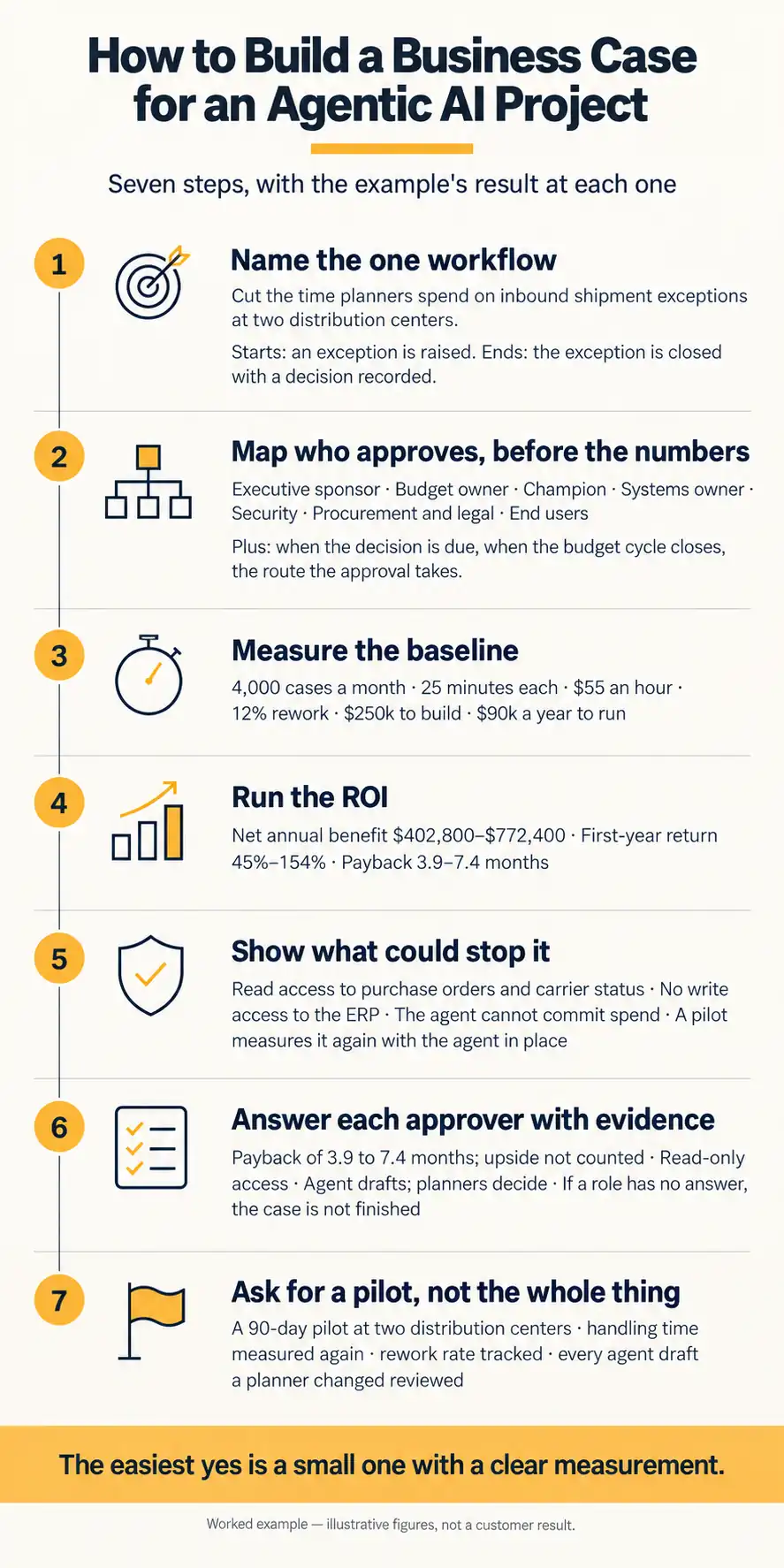
Text version of the seven steps
- Name the one workflowCut the time planners spend on inbound shipment exceptions at two distribution centers · an exception is raised · the exception is closed with a decision recorded
- Map who approves, before the numbersExecutive sponsor · Budget owner · Champion · Systems owner · Security · Procurement and legal · End users · when the decision is due, when the budget cycle closes and the route the approval takes
- Measure the baselineCase volume per month · Handling time per case · Loaded cost per hour · Error or rework rate · Implementation cost estimate · Annual run cost
- Run the ROINet annual benefit $402,800 to $772,400 · First-year return 45% to 154% · Payback 3.9 to 7.4 months
- Show what could stop itread access to purchase orders and carrier status · It needs no write access to the ERP · The agent cannot commit spend · A pilot measures it again with the agent in place
- Answer each approver with evidencepayback of 3.9 to 7.4 months; upside not counted · Read-only access to orders and carrier status · Agent drafts; planners decide · If a role has no answer, the case is not finished
- Ask for a pilot, not the whole thinga 90-day pilot at two distribution centers · handling time per exception measured again · the rework rate tracked · every agent draft that a planner changed reviewed
The easiest yes is a small one with a clear measurement.
Step 1: Name the one workflow
Start with one workflow, with a clear start and end, that someone owns. “Use AI across the supply chain” is not a case anyone can approve. “Cut the time planners spend on inbound shipment exceptions at two distribution centers” is.
Write down where the workflow starts (an exception is raised), where it ends (the exception is closed with a decision recorded), which systems it touches (ERP, carrier portals, email) and who owns it today (the logistics operations director). In the canvas, this becomes the problem, the workflow and the systems sections. For more on choosing the first workflow, read why the best first AI project is a handoff.
Step 2: Map who approves, before the numbers
Most cases are built numbers first and approvers last. Reverse it. Each approver needs a different piece of evidence, and knowing who they are tells you which baselines to collect.
Record approvers by role and title, not by name. You will share the case widely, and the case does not need anyone’s personal details to work.
| Role | Title in the example | What they need to see |
|---|---|---|
| Executive sponsor | VP, Supply Chain | How this fits the year’s service-level goals |
| Budget owner | Finance director, supply chain | The baseline, the cost to build and run, and payback |
| Champion | Director, Logistics Operations | That planners get time back and keep control |
| Systems owner | ERP platform lead | What access the agent needs, read or write |
| Security | Information security manager | Where supplier and order data goes, and who sees it |
| Procurement and legal | Category manager, IT services | Contract terms and data processing |
| End users | Lead planner | What the agent drafts, and what planners still decide |
Then note three dates: when the decision is due, when the budget cycle closes and the route the approval takes (for example, sponsor, then finance, then the IT investment board). A good case that lands a week after the budget closes waits a year.
Step 3: Measure the baseline
The ROI is only as good as the baseline under it. Agentic ROI needs three numbers to produce a range at all, and three more to show net benefit, ROI and payback. In the example, the champion supplies them, and the case says where each comes from.
| Baseline | Example value | Where it comes from |
|---|---|---|
| Case volume per month | 4,000 exceptions | Exception log export, last six months |
| Handling time per case | 25 minutes | A two-week time study with four planners |
| Loaded cost per hour | $55 | Finance’s loaded rate for the planner role |
| Error or rework rate | 12% | Exceptions reopened after closure |
| Implementation cost estimate | $250,000 | The seller’s statement of work |
| Annual run cost | $90,000 | Platform, model usage, review time, monitoring and support |
Mark which figures are measured and which are estimates. In the example, volume and rework come from system data, handling time from a short study, and both costs are estimates until the contract is priced. The budget owner will ask, and an honest label earns more trust than a confident guess.
Step 4: Run the ROI
With those baselines, Agentic ROI shows the following. Every line is a range because nobody knows in advance how much of the handling time an agent will take on. The app plans on 40 to 70 percent of it being recovered and shows both ends.
| Line | Result | How it is calculated |
|---|---|---|
| Handling time today | 20,000 hours a year | 4,000 × 12 × 25 minutes |
| Time recovered | 8,000 to 14,000 hours a year (4.5 to 8.0 FTE) | 40 to 70% of handling time; 1,760 hours per FTE |
| Labor savings | $440,000 to $770,000 a year | Recovered hours × $55 |
| Avoided rework | $52,800 to $92,400 a year | 12% of handling hours × 40 to 70% × $55 |
| Cashable benefit | $492,800 to $862,400 a year | Labor savings + avoided rework |
| Net annual benefit | $402,800 to $772,400 | Cashable benefit − $90,000 run cost |
| First-year return | 45% to 154% | (Benefit − year-one cost) ÷ year-one cost of $340,000 |
| Payback | 3.9 to 7.4 months | $250,000 ÷ net annual benefit |
- 20,000 hours a yearHandling time today
- 8,000 to 14,000 hours a year (4.5 to 8.0 FTE)Time recovered
- $402,800 to $772,400Net annual benefit
- 45% to 154%First-year return
- 7.4 monthsAt 40 percent, the project still pays back
The low end matters more than the high end.
Two things are deliberately left out. Fewer expedited shipments and better on-time delivery are real benefits, but they depend on decisions the agent does not make, so the case lists them as expected and does not count them. And the recovered time is shown once, as savings or as capacity, never both. The finance lead will check for double counting, and this case gives them nothing to find.
The low end matters more than the high end. At 40 percent, the project still pays back in 7.4 months. That is the number to lead with, because it is the one a skeptical budget owner can accept. Read more about how the ranges work in the Agentic ROI guide.
Step 5: Show what could stop it
A case that only shows upside reads like a pitch. Show what has to be true for the value to appear, and what you will do if it is not.
- Data access. The agent needs read access to purchase orders and carrier status. It needs no write access to the ERP. Say so plainly; it answers the systems owner’s first question.
- Supplier data. Supplier names and order details go to the model. The case states where they are processed, how long they are kept and who can see them. That is the security lead’s section.
- Human control. A planner approves every supplier email and every proposed next step. The agent cannot commit spend. That is what the champion and the lead planner need to hear.
- The handling-time figure. It comes from a two-week study. A pilot measures it again with the agent in place.
The readiness check and the governance and safety guide go through these questions in more depth.
Step 6: Answer each approver with evidence
Go back to the approver map and, for each role, point to the part of the case that answers them. If a role has no answer, the case is not finished.
| Approver | Their question | The answer in the case |
|---|---|---|
| Finance director | Is the number real? | Baselines with sources; payback of 3.9 to 7.4 months; upside not counted |
| ERP platform lead | What does it touch? | Read-only access to orders and carrier status |
| Security manager | Where does the data go? | Data handling section, retention and access |
| Lead planner | What happens to my job? | Agent drafts; planners decide; 4.5 to 8.0 FTE of time back for planning |
| VP, Supply Chain | Why this, why now? | One workflow, a 90-day pilot at two distribution centers, a decision before the budget closes |
Step 7: Ask for a pilot, not the whole thing
The easiest yes is a small one with a clear measurement. In the example, the ask is a 90-day pilot at two distribution centers. Success is defined before it starts: handling time per exception measured again, the rework rate tracked, and every agent draft that a planner changed reviewed. At day 90, the case is updated with measured numbers in place of estimates, and the full rollout is decided on those.
The implementation plan guide covers how to scope that pilot.
One case, many proposals
If you sell, you will write this case more than once. Most of it carries over. The workflow, the approver map, the risk answers and the pilot structure stay the same from one manufacturer to the next. The baselines change. Keep the structure and replace the six numbers with each buyer’s own, and the ROI recalculates from their figures, not yours.
That is also the honest way to do it. A case built on the buyer’s numbers survives their finance review. A case built on an industry average usually does not.
Frequently asked questions
What is a business case for an AI project?
It is the argument for approving one AI project: the workflow it changes, what that workflow costs today, what the change is worth, what it costs to build and run, what could go wrong, and who has to say yes. A pitch describes a product. A business case argues for a decision.
Who is in the decision-making unit for an agentic AI project?
Usually an executive sponsor, a budget owner in finance, the owner of the systems the agent touches, security, procurement or legal, and the team whose work changes. Each one needs a different piece of evidence, so name them by role before you build the numbers.
Where do the ROI numbers come from?
From the buyer’s own baselines: how many cases a month, how long each takes, what an hour costs, how often work is redone, and what the project costs to build and run. Agentic ROI turns those into ranges with a stated basis. If a baseline is missing, the range stays hidden rather than guessed.
Why a range and not a single number?
Nobody knows in advance how much of a workflow an agent will take on. Agentic ROI plans on 40 to 70 percent of the handling time being recovered and shows both ends. A pilot then measures where the real figure lands.
Can one business case serve many proposals?
Yes, if the workflow is the same. Keep the structure, the approver map and the risk answers, and replace the baselines with each buyer’s own figures. The numbers change; the argument does not.
Build the case in Agentic AI Canvas
Agentic AI Canvas holds the whole case in one place: the workflow, the systems, the people involved, the baselines and the ROI ranges, the readiness gaps and the risks. Start in Instant Chat with the workflow you want approved, then open Agentic ROI and enter the buyer’s baselines. The canvas keeps the evidence labels, so every number in the case says whether it was measured or estimated.
Start a planning conversation with the workflow you need approved.